The Best POS System for a Small Grocery Store or Bodega in 2026
July 14, 2026 - The Chote Team
If you are looking for the best POS for a small grocery store - a corner bodega, a family-run ethnic market, or a neighborhood convenience shop - the honest answer is that no single system works equally well for every store. Square and Clover are strong, well-supported platforms that millions of businesses rely on.
But neither was designed with the immigrant-owned, multilingual, cash-and-EBT-heavy grocery in mind. This guide gives a fair look at each: what they genuinely do well, where they fall short for this specific kind of store, and where a newer tool called Chote closes the gap.
The systems compared in this guide



Why your POS choice matters more than you think
Independent grocers run on some of the thinnest margins in retail: net profit for a single-store independent grocer typically sits between 1 and 2 percent of revenue, per the Independent Grocers Financial Report1. A store doing $150,000 a month might keep $1,500 to $3,000 after expenses - and spoilage alone can quietly erase 2 to 5 percent of revenue. The wrong cost structure, inventory tools, or language support chips directly into that.
A $120k/month bodega: monthly profit vs avoidable waste
At a 1.5% net margin, with 3% spoilage from poor inventory tracking. Illustrative.
- Net profit: $1,800/mo
- Spoilage (3%): $3,600/mo
Waste can exceed a small store's entire net profit. Closing even half of it with expiry tracking can beat almost any other improvement the owner makes this year.
Square: a low barrier to entry, but built for everyone
Square is one of the most popular entry points for small retail, and for good reason. The free tier has no monthly software fee; in-person processing runs 2.6% + $0.15 on that plan, per Square's pricing2. No contract, no large upfront commitment, a clean interface, and a broad ecosystem from invoicing to payroll.
The trade-off is that Square is a horizontal platform, built to work for a yoga studio and a coffee cart as well as a grocery. That generality means no expiry tracking, no natively integrated SNAP EBT, and no multilingual staff interface. For a simple store doing mostly card sales with English-fluent staff, Square is perfectly adequate - it is the perishables-heavy, diverse-language stores where the generic design shows its limits.
Clover: more grocery-capable, but the cost adds up fast
Clover is a step up in grocery capability, with a broader set of retail configurations and a richer app marketplace. If you need more customization than Square's base offering, it is a reasonable consideration. The challenge is total cost of ownership.
Clover hardware runs from a few hundred dollars for a handheld up into the four figures for countertop stations, monthly software starts around $14.95, and it typically requires a 36- to 48-month contract with early-termination fees. For a store on a 1-2 percent net margin, a four-figure hardware commitment plus multi-year lock-in carries real risk - and monthly fees, processing, and add-on apps push the true spend well past the base plan.
Clover is not a bad product. Merchants who need a robust, configurable retail POS and can absorb the upfront cost often find it worth it. The point is that for a small, tight-margin grocery - especially one just getting started - the hardware commitment and contract lock-in are real risks.
The gap both systems leave open
Both Square and Clover are primarily English-language platforms, and that matters more than it seems. There are hundreds of thousands of immigrant-owned bodegas and ethnic markets where the owner, staff, and regulars may all share a primary language that is not English. A checkout no one at the register is fully comfortable in slows transactions and invites errors - and there is a simple dignity issue: these owners deserve tools built for how they actually work.
SNAP EBT is another gap for generic platforms. In many small urban grocery stores, SNAP is a meaningful share of daily volume, and it requires split-tender handling, SNAP-eligible item separation, and USDA compliance. A POS that does not handle this natively forces workarounds that add checkout time and error risk.
Food waste compounds the margin problem. ReFED and the USDA3 estimate US grocery food waste at a large share of what is stocked, and the NRDC4 notes that pulling products days early removes an estimated hundreds of millions of dollars of edible food a year.
For a small store without automated expiry alerts, managing this by hand means either letting product spoil or pulling it too early. Both cost money a 1-2 percent margin store cannot spare.
Where Chote fits: built for the store Square and Clover were not
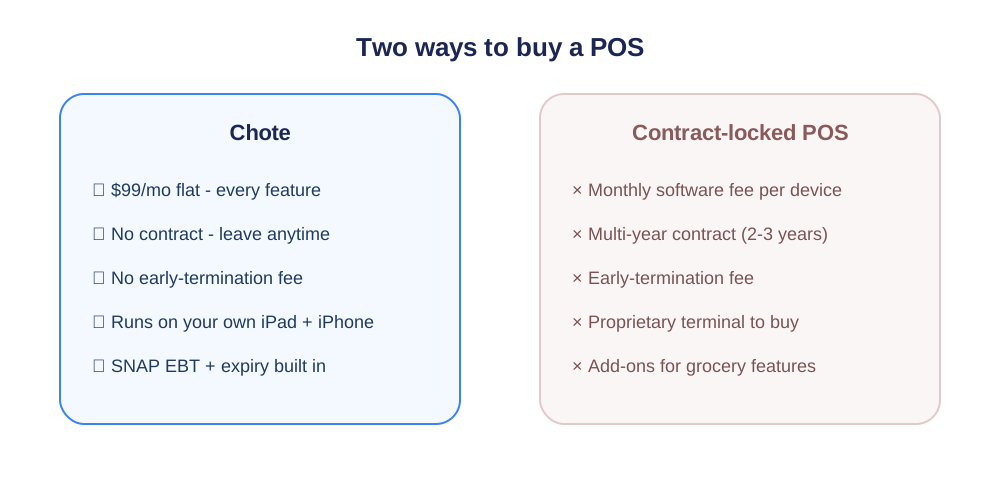
Chote is a mobile POS designed specifically for small, independent, and immigrant-owned grocery and corner stores. It is $99 a month, flat, for every feature and runs on unlimited iPhones and iPads you likely already own, with hardware provided - no per-device fees, no large upfront cost. That alone removes the financial barrier that makes a system like Clover inaccessible to a store opening on limited working capital.
The design choices are deliberate. Chote supports more than 20 languages - including Arabic, Spanish, and Hindi - so owners and staff run the store in the language they actually think in. It is not a translated help doc; it is the checkout interface itself. It accepts SNAP EBT natively on the same device as card, and its inventory includes expiry and waste alerts so you can discount, rotate, or pull stock before it becomes a write-off.
A direct comparison at a glance
| Chote | Square | Clover | |
|---|---|---|---|
| Monthly software fee | $99/mo flat, unlimited devices. | $0 free tier / $49 Plus. | From ~$14.95/mo. |
| Hardware | Yes - Your own iPad; up-to-100% free hardware program. | Partial - Your device, or Square hardware. | No - Proprietary terminals, hundreds to four figures. |
| Contract | Yes - No lock-in. | Yes - Month-to-month. | No - Typically 36-48 months, with ETF. |
| SNAP EBT | Yes - Built in, on one device. | No - Not native; needs a separate app + reader. | Yes - Native on PIN-capable devices. |
| Expiry + waste alerts | Yes - Built in for grocery inventory. | No - Not in scope. | No - None native; paid add-on only. |
| Multilingual interface | Yes - 20+ languages incl. Arabic, Spanish, Hindi. | Partial - English and Spanish. | Partial - English-primary. |
| Grocery specialization | Yes - Purpose-built for small grocery + corner stores. | No - Generic retail. | Partial - Broad retail + app marketplace. |
Publicly listed rates, July 2026. Full source list at the end of this article.
To be clear: Square and Clover are not bad choices for every store. A single-owner shop doing mostly card sales with English-fluent staff may do fine on Square at near-zero cost. A store that can absorb Clover's upfront cost and needs a configurable ecosystem may find it worthwhile. The argument is only that they were not designed for the constraints of a small, immigrant-owned, multilingual grocery - and the misalignment shows in the details.
The business case for getting this right
Take that $120,000-a-month bodega at a 1.5 percent net margin - $1,800 a month in profit. If poor tracking causes 3 percent spoilage, that is $3,600 a month in waste, more than twice the profit. Closing even half that gap with expiry tracking could beat any other improvement the owner makes this year. A POS that includes those tools, runs in the owner's language, handles SNAP correctly, and costs nothing upfront is not a convenience - it is a financial tool.
Choose Square or Clover if
- You do mostly card sales with English-fluent staff and light inventory (Square).
- You can absorb four-figure hardware and a multi-year contract for a configurable ecosystem (Clover).
- SNAP EBT and expiry tracking are not central to your day.
Choose Chote if
- You run a small, immigrant-owned or multilingual grocery or bodega.
- SNAP EBT is a real share of your daily volume.
- You lose margin to spoilage and need expiry alerts.
- You want to start free, on hardware you own, with no contract.
Sources
- Independent Grocers Financial Report / research - National Grocers Association, accessed July 2026
- Retail POS Pricing & Plans - Square, accessed July 2026
- The Problem of Food Waste - ReFED, accessed July 2026
- Wasted: How America Is Losing Up to 40 Percent of Its Food - NRDC, accessed July 2026
- Clover POS System Pricing - Clover, accessed July 2026
Frequently asked questions
What is the best POS system for a small grocery store or bodega in 2026?
It depends on your store's specific needs. Square is a solid no-monthly-fee option for simple setups with English-fluent staff. Clover is more configurable but carries higher hardware and contract costs. For immigrant-owned or multilingual grocery stores that accept SNAP EBT and need expiry tracking, a purpose-built option like Chote - which is $99/month flat for every feature and supports 20+ languages - is worth a close look.
Does Square work for a grocery store that accepts SNAP EBT?
Square's core free product does not natively handle SNAP EBT. Stores that process a meaningful share of SNAP transactions typically need a system with built-in EBT support to handle split-tender transactions and SNAP-eligible item separation correctly.
How much does Clover cost for a small grocery store?
At publicly listed pricing at the time of writing, Clover hardware runs from roughly $749 for the handheld Flex to $1,799 to $1,899 for countertop Station units. Monthly software fees start around $14.95. Clover typically requires a 36 to 48-month contract. Total cost including processing fees can run well above the base plan cost once hardware, software, and add-ons are factored in.
Can a POS system help reduce food waste in a small grocery store?
Yes. A significant share of grocery spoilage results from poor expiry tracking rather than unavoidable loss. A POS with built-in expiry and waste alerts lets store owners flag products approaching their dates and act - discounting, rotating stock, or pulling items - before they become write-offs. Given that spoilage can cut a small store's margins by 2 to 5 percent, this is a meaningful operational gain.
Is there a POS system that works in Spanish, Arabic, or Hindi for store owners and staff?
Most mainstream POS platforms are English-primary. Chote is designed specifically to support 20+ languages including Spanish, Arabic, and Hindi, so owners and staff can operate the checkout interface in the language they are most comfortable with.
Do I need expensive hardware to run a grocery store POS?
Not necessarily. Some systems like Square offer a low-cost entry point using an iPad you already own. Chote runs on a standard iPad rather than a proprietary, locked-in terminal, and offers an up-to-100% free hardware program - so you avoid the $750 to $1,900 dedicated-terminal cost that systems like Clover typically require.
What are the biggest POS challenges for immigrant-owned grocery stores?
The three most common friction points are: (1) English-only interfaces that slow down checkout for staff and owners who operate in another language; (2) lack of native SNAP EBT support, which forces manual workarounds for a payment type that represents a high share of transactions in many small urban stores; and (3) no expiry or waste tracking, which silently drains already-thin margins through spoilage.